I built Lumi to learn RAG. Here’s why we open-sourced it.
In the early days of generative AI, I built the first version of Lumi to learn how retrieval-augmented generation worked in practice. Nieve’s website gave me a concrete test. If someone asked, “Have you worked on a project like ours?”, could a chatbot find a relevant case study and use it to give a useful answer?
That question made for a good proof of concept. It was specific enough that I could tell whether the retrieval had worked. A fluent answer based on the wrong project was still the wrong answer.
Once Lumi was on our website, the questions changed. Who keeps the information current? What should the assistant ask before suggesting a meeting? How does the team see what happened when a conversation goes nowhere? Each question gave me another piece of the system to build.
What is Lumi?
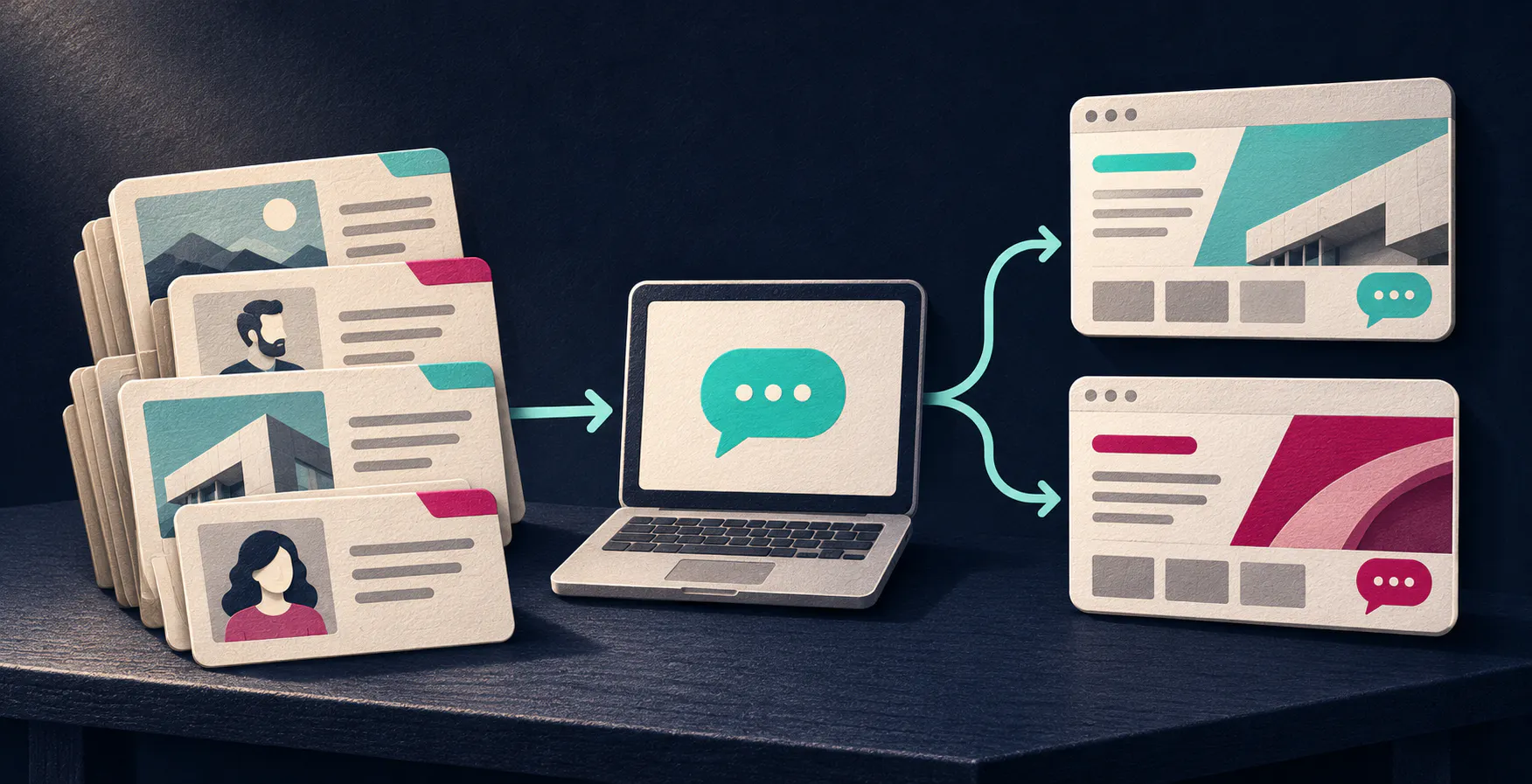
Lumi is an AI website concierge for service businesses. Its embeddable chat answers questions using a company’s own knowledge, asks configurable qualification questions, and helps visitors book a conversation or send an inquiry. The team can manage that knowledge and review conversations in an admin interface. Lumi on GitHub
At Nieve, Lumi also powers the team and project pages on our website. The team profiles and project descriptions we show on those pages are the same records Lumi can draw from in a conversation. When we add a case study or update someone’s profile, we do it in one place. A visitor can browse the project page or ask Lumi which projects are relevant to their situation, and both paths draw on the same information.
Why Lumi?
The turning point came when I could configure Lumi for another agency without creating a fork. I could give it a different identity, point it at a different set of services and case studies, and decide what should happen when a visitor wanted to talk to someone. The same application could run on both sites.
That was a useful test because agencies differ in exactly those places. A consultancy might want to ask what systems a prospect needs to integrate before offering a meeting. A design studio might ask about the scope and timing of a rebrand, then send the inquiry to the right person. Each team needs to decide which questions matter, which examples to draw on, and when to hand the conversation over. Those choices belong in configuration.
Once Lumi could support those differences, it made sense for us at Nieve to open-source it. An agency can run Lumi on its own site, adapt it for a client, or inspect how a conversation gets from a question to a booking. The application is available under AGPL v3, and the embeddable widget is licensed separately under Apache 2.0. You can self-host Lumi with Docker Compose or have Nieve host it.
What’s next?
The first hour with Lumi is where I’d like to make the biggest improvement. After adding a website and a few case studies, a team should be able to ask the questions its clients actually ask and preview the answers before putting the widget live. Try a question with a clear answer, one that needs a case study, and one your site barely covers. Each tells you something different about what Lumi is ready to handle.
After launch, I want teams to be able to see which questions go unanswered and send inquiries into the tools they already use. We’re also exploring how agencies might manage several client installations. I’m particularly interested in hearing which parts of setting up and running Lumi agencies find themselves repeating across clients. That feedback will help us decide what to build first. Lumi’s public roadmap
If you’re curious, start the way I did. Take a question a prospective client asks your agency and see what Lumi can find about it. You can try Lumi on Nieve’s site, or run it with your own case studies and share what you find in GitHub Issues.

Chief Technical Officer